Ground-Truthing Your LLM Judge: Does Your Eval Actually Track Reality?
LLM-as-judge has quietly become the default way to evaluate AI systems. You can’t hand-grade thousands of agent runs, so you ask a model: is this output good? It’s cheap and it scales, and suddenly you have numbers.
But the judge is just another unreliable model. You added an LLM to grade your LLM, and now you trust the grades. Nobody’s checking the checker.
Mostly nobody is. Teams tune prompts and ship models based on a judge’s pass rate without ever checking whether “the judge said pass” tracks “this actually worked.” That’s a second opinion from someone with your exact blind spots.
Cross-tab the judge against ground truth
You almost always have a ground-truth signal already. You’re just not using it to grade the grader. The signal is whatever actually happened downstream:
- For generated code: did it merge? did it pass CI? did a human approve it?
- For a support answer: did it resolve the ticket, or did the user escalate?
- For a retrieval answer: did the user click through, accept, or retry?
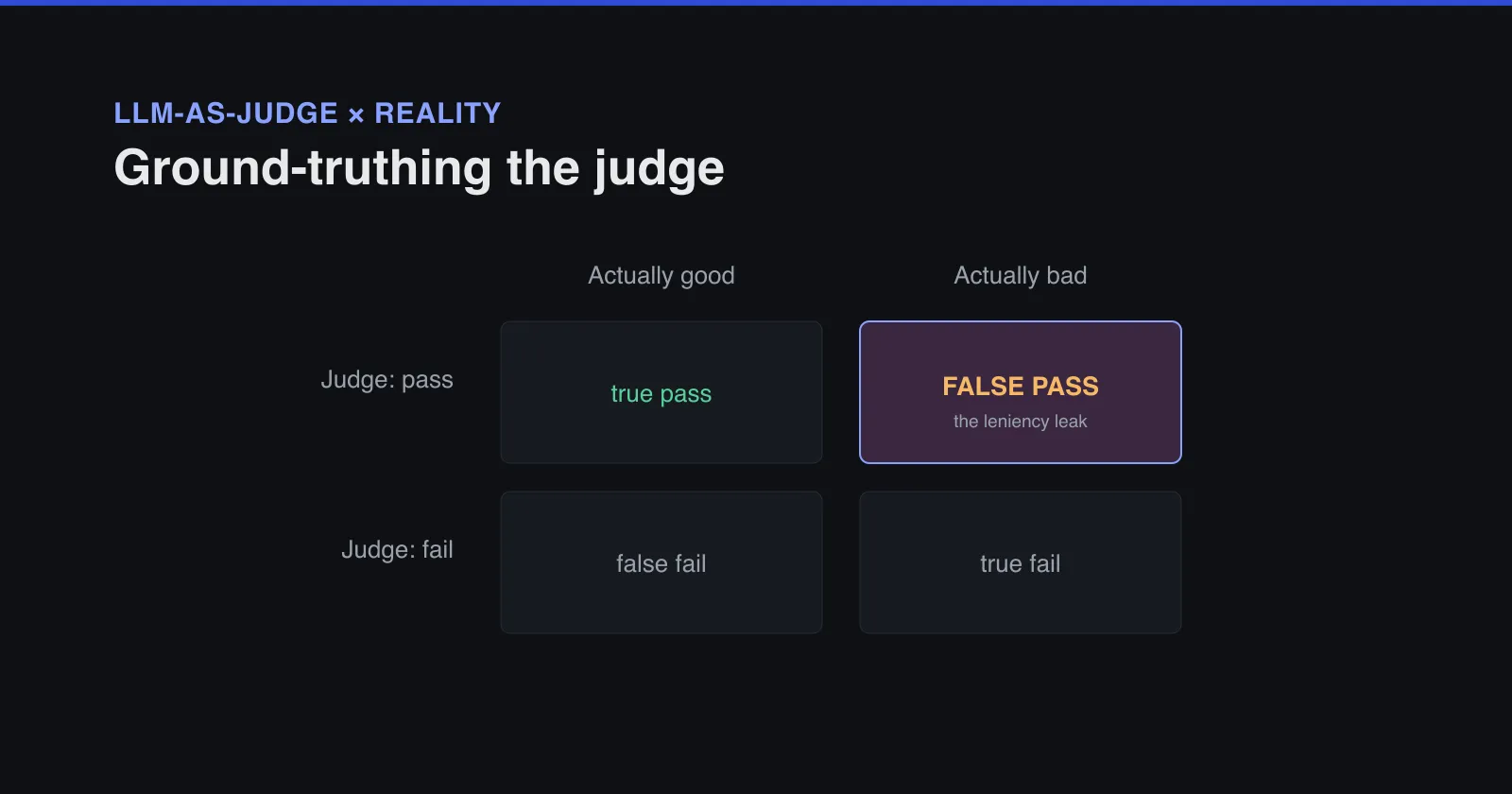
It’s simple enough that people skip it: build a confusion matrix between the judge’s verdict and the real outcome.
| Actually good | Actually bad | |
|---|---|---|
| Judge said pass | true pass | false pass |
| Judge said fail | false fail | true fail |
Now your judge has a precision and recall against reality, like any classifier. And now you can see the thing that was invisible before: the shape of its mistakes.
What I found: judges are lenient
In my own work (an LLM judge scoring AI-generated changes, cross-tabbed against whether those changes actually merged), the dominant error was systematic leniency: the judge waved through work that didn’t hold up downstream far more often than it wrongly rejected good work. The false-pass cell was the heavy one.
That makes sense if you think about how these judges are prompted. “Rate this response” with a friendly rubric optimizes for plausibility, and plausible-but-wrong is exactly the failure mode LLMs are best at producing. A judge reading a confident, well-structured answer is inclined to bless it, the same way a human reviewer rubber-stamps a clean-looking PR that turns out to be broken.
Leniency is the dangerous direction, too. A judge that’s too harsh wastes your time. A judge that’s too lenient ships the failures you built the eval to catch, while giving you a green dashboard.
Fixing it: guards for the crisp parts, the judge for the fuzzy part
Once you can see the disagreement, two things help.
1. Take work away from the judge. A lot of what people ask an LLM judge to check is
deterministic: is the output valid JSON? does it contain the required fields? did the code compile?
did the tests run? You don’t need a probabilistic grader for any of that. You need an if
statement. Put deterministic verdict guards in front of the judge so it only adjudicates the
genuinely fuzzy question (“is this good?”), never the mechanical ones. Every check you can make
deterministic is a check that can’t drift.
2. Recalibrate the judge from the disagreement cells. The false-pass and false-fail examples are the most valuable data you have. They’re literally the cases where your instrument is wrong. Feed them back: tighten the rubric around the specific ways it’s being fooled, add them as few-shot counter-examples, or split a vague criterion into concrete ones. Then re-run the cross-tab and watch the false-pass cell shrink.
The point isn’t a single before/after number. You now have a loop: the judge stops being a fixed oracle you hope is right and becomes an instrument you can point at reality and tighten.
Where this gets messy
- Ground truth is often delayed and noisy. A merge isn’t a perfect label: good changes get reverted, bad ones slip through review. Treat the outcome as a strong signal, not gospel; you’re looking for systematic divergence, not litigating individual cases.
- Not every task has a clean outcome. Some outputs never get a downstream verdict. For those, you’re stuck with the judge, which is exactly why you want to calibrate it on the tasks that do have ground truth and carry that trust over carefully.
- You can overfit the judge to the guard. If you recalibrate too aggressively on one batch of disagreements, you can teach it that batch instead of the general rule. Hold out a fresh slice of outcomes to check.
The takeaway
Your eval is a measurement instrument, and instruments need calibration against reality, otherwise you’re just measuring your own assumptions. An LLM judge that nobody has cross-checked against outcomes only measures how confident it sounds.
So before you trust the next pass rate: pull the outcomes you already have, build the four-cell table, and look at how big the false-pass corner is. It’s usually bigger than you’d like, and that’s the most useful thing your eval has told you all quarter.
Prefer plain text? Read this as Markdown.