Probabilistic Prompt Pipelines · Part 1
Why Static Prompts Fail and How Probabilistic Selection Fixes It

This is the first post in a four-part series on building production-ready probabilistic prompt pipelines. By the end of this post, you’ll understand why static prompts become bottlenecks and see a working example of how probabilistic selection creates self-improving systems.
When a Good Prompt Becomes a Ceiling
Imagine you’ve built a successful application that uses large language models to generate personalized wellness podcasts. Your users love the content, engagement is strong, and everything seems to be working well. You’ve crafted the perfect prompt through weeks of careful iteration, testing different approaches until you found the golden template that consistently produces engaging, accurate episodes.
But then something subtle starts happening. User feedback suggests the episodes are becoming predictable. Every script seems to mention drinking more water in the same way. The tone feels repetitive. Newer users from different wellness backgrounds aren’t engaging as well as your original audience. When you try to improve the prompt, you discover that any change risks breaking the quality you’ve achieved, and testing every modification requires extensive manual review.
This scenario shows the core limitation of static prompt engineering. What starts as a solution becomes a constraint. The very thing that gave you initial success, a carefully crafted fixed prompt, eventually becomes the ceiling that prevents further improvement.
Your original prompt was fine. The issue is that static prompts can’t adapt to changing conditions, evolving user preferences, or new types of content. They’re like having a single recipe that you must use for every meal, regardless of the ingredients available, the season, or your dinner guests’ preferences.
Understanding Why Static Prompts Break Down
Static prompts create three core problems in production systems. Each one compounds over time, making the system increasingly brittle and difficult to improve.
The Staleness Problem: When Success Becomes Repetition
The first issue emerges precisely because your prompt works well. When you find a prompt that generates good content, you naturally want to keep using it. But success in one context doesn’t guarantee success in every context, and what worked for your initial user base might not work for new audiences or changing conditions.
Consider our podcast example. Suppose your original prompt includes this instruction: “Always emphasize the importance of staying hydrated as the foundation of good health.” This guidance might have worked perfectly for your initial audience of fitness enthusiasts just beginning their wellness journey. But as your podcast grows and attracts listeners who already have solid hydration habits, this advice becomes repetitive and irrelevant.
The prompt that once felt fresh and valuable now feels stale and predictable. Your long-time listeners start skipping episodes because they feel like they’ve heard the same advice repeatedly. New listeners with different wellness goals bounce off because the content doesn’t address their specific needs. The prompt hasn’t changed, but the context around it has evolved, and static prompts cannot adapt to these changes.
This staleness isn’t just about repetitive content themes. It also affects writing style, tone, and approach. If your prompt always leads with motivational quotes, every episode starts the same way. If it always follows a specific structure, the format becomes predictable. What once felt engaging becomes mechanical, even when the underlying content is valuable.
The Bottleneck Problem: When Updates Become Dangerous
The second major issue with static prompts is that they create dangerous deployment bottlenecks. When your entire content generation system depends on a single prompt, any change to that prompt affects every piece of content you generate. This creates a situation where improvement becomes risky and expensive.
Think about what happens when you want to test a new approach. Maybe you’ve noticed that episodes mentioning specific, measurable wellness actions tend to perform better, so you want to modify your prompt to encourage more concrete recommendations. With a static prompt, this change affects every episode you generate going forward. If the modification works well, great. But if it causes quality to drop or introduces unexpected problems, every episode during the testing period is potentially compromised.
This risk makes teams conservative about prompt improvements. Instead of iterating quickly and learning from data, you end up making changes slowly and cautiously. Each modification requires extensive testing, review, and validation before deployment. What should be a fast feedback loop becomes a laborious process that discourages experimentation and slows improvement.
The bottleneck becomes even more pronounced when you want to A/B test different approaches. With static prompts, you typically need to run separate systems or carefully manage traffic splitting, adding operational complexity and making it harder to gather clean experimental data. The infrastructure that should enable rapid learning instead makes learning more difficult.
The Invisible Regression Problem: When Quality Silently Degrades
The most damaging problem with static prompts is that they can degrade in quality without anyone noticing. This happens because the external environment changes while your prompt remains fixed, creating a mismatch that develops gradually.
Language models themselves evolve. When Claude 3.5 receives updates, the way it interprets your prompt might shift slightly. Wellness trends change, affecting what health advice resonates with audiences. User demographics shift as your application grows. Competitive products launch, changing user expectations. All of these factors influence content quality, but with static prompts, you have no automatic mechanism to detect or respond to these changes.
Consider a concrete example. Suppose your wellness podcast prompt was optimized during a period when high-intensity workouts were trending. The advice it generates assumes users are interested in vigorous exercise routines and focuses on performance optimization strategies. But then wellness culture shifts toward gentle movement and stress reduction due to increased awareness of burnout. Your prompt continues generating content optimized for high-intensity fitness, but this advice becomes less relevant and potentially counterproductive during a period when audiences are prioritizing rest and recovery.
Without systematic monitoring and evaluation, you might not notice this quality degradation until user engagement drops significantly or you receive explicit negative feedback. By then, you may have generated weeks or months of suboptimal content. The static prompt provided no early warning system and no automatic adaptation mechanism.
Introducing Probabilistic Prompt Selection
Now that we understand why static prompts become limiting, here’s a different approach. Instead of relying on a single carefully crafted prompt, what if we maintained a portfolio of prompt templates and selected among them based on data?
This is the core idea behind probabilistic prompt selection. The question changes from “What’s the best prompt?” to “What’s the best prompt for this specific situation, given everything we’ve learned so far?” This shift from fixed to adaptive selection changes how content generation systems can improve.
The basic concept works like this: imagine you have five different prompt templates, each with a slightly different approach to generating wellness advice episodes. Template A emphasizes concrete examples and specific health metrics. Template B focuses on personal stories and emotional connection. Template C takes a data-driven approach with charts and statistics. Template D emphasizes actionable steps and practical implementation. Template E balances multiple perspectives and acknowledges complexity.
Instead of picking one template and using it forever, you let the system choose which template to use for each episode based on two key factors. First, which templates are most appropriate for the current episode’s context? If the episode is about low-impact exercise for someone with a history of injuries, templates that acknowledge complexity might be more appropriate than those focused on simple actionable steps.
Second, which templates have historically performed best? If Template B has consistently generated episodes with higher engagement rates, it should be selected more frequently than templates that produce average results. The selection should be probabilistic, not deterministic. Even if Template B is the historical best performer, the other templates should still have some chance of being selected, because circumstances change and you need to keep learning about their effectiveness.
This probabilistic approach solves all three problems we identified with static prompts. It prevents staleness by naturally rotating between different approaches. It eliminates the bottleneck problem by allowing safe experimentation without risking the entire system. And it provides automatic detection of quality changes by continuously monitoring the performance of different approaches.
Why Claude 3.5 Sonnet for Creative Content Generation?
We chose Claude 3.5 Sonnet for this podcast generation system, and the choice illustrates a principle about building production systems: empirical performance beats theoretical capability.
Claude 4 excels at analytical reasoning and precise instruction-following, but Claude 3.5 Sonnet fits creative content generation better. Newer doesn’t always mean better for a specific use case.
Creative content like podcast scripts requires a model that can be engaging, conversational, and naturally expressive while still following the structural requirements we specify. Claude 3.5 Sonnet was specifically optimized with creative writing as a core focus, and it maintains a certain spontaneity and personality that translates into more engaging audio content.
In our testing, Claude 3.5 Sonnet consistently produced scripts that felt more conversational and less formal than Claude 4’s output. The newer model’s increased precision worked against us in creative contexts: it would follow instructions so exactly that the output sometimes felt robotic or overly structured. Think of it like the difference between a skilled technical writer and a natural storyteller. Both have their place, but for content that needs to capture and hold human attention, the storyteller’s approach often works better. This is a specific observation for this use case, not a general rule. In some follow-up experiments, Claude 4 performed better when the prompt became more specific and directive, which suggests it may improve as the prompts themselves get more specific and tuned.
The model that works best for your specific use case and success metrics should guide your decision, regardless of which model is newest or highest on general benchmarks.
A Simple Working Example
Here’s how probabilistic prompt selection works in practice. We’ll start with a simplified version that shows the core concepts.
Imagine we have three prompt templates for generating wellness advice episodes:
Template A (Concrete Focus): “Create a wellness advice episode that uses specific health metrics and real-world examples. Include at least three concrete scenarios with actual numbers and examples that illustrate your points. Make the advice actionable and specific rather than general.”
Template B (Story-Driven): “Create a wellness advice episode that centers around a relatable personal story or case study. Use narrative techniques to make the wellness concepts engaging and memorable. Connect emotional aspects of wellness to practical advice.”
Template C (Data-Informed): “Create a wellness advice episode that incorporates relevant health data, trends, or research. Use statistics and wellness trend information to support your recommendations. Present evidence-based advice with clear reasoning.”
Now, instead of choosing one template and sticking with it, our system tracks how well each template performs and selects among them probabilistically. Here’s a simplified version of how this works:
import random
import numpy as np

class SimplePromptSelector:
    def __init__(self):
        # Track performance for each template
        # We start with some initial success/failure counts (prior knowledge)
        self.template_stats = {
            'concrete_focus': {'successes': 2, 'failures': 1},  # 2 good, 1 poor episode
            'story_driven': {'successes': 3, 'failures': 1},   # 3 good, 1 poor episode
            'data_informed': {'successes': 1, 'failures': 1}   # 1 good, 1 poor episode
        }

        self.templates = {
            'concrete_focus': "Create a wellness advice episode that uses specific health metrics and real-world examples...",
            'story_driven': "Create a wellness advice episode that centers around a relatable personal story...",
            'data_informed': "Create a wellness advice episode that incorporates relevant health data..."
        }

    def select_template(self):
        """
        Use Thompson Sampling to select a template.

        Thompson Sampling works by sampling from each template's estimated
        performance distribution, then selecting the template with the highest
        sampled value. This naturally balances using proven winners while
        still exploring potentially better options.
        """
        sampled_scores = {}

        # For each template, sample from its performance distribution
        for template_name, stats in self.template_stats.items():
            successes = stats['successes']
            failures = stats['failures']

            # Sample from Beta distribution - this captures our uncertainty
            # about the template's true performance
            sampled_score = np.random.beta(successes, failures)
            sampled_scores[template_name] = sampled_score

        # Select the template with the highest sampled score
        best_template = max(sampled_scores.keys(), key=lambda x: sampled_scores[x])

        return {
            'template_name': best_template,
            'template_text': self.templates[best_template],
            'sampled_scores': sampled_scores  # For debugging/monitoring
        }

    def update_performance(self, template_name, was_successful):
        """
        Update our knowledge about a template's performance.

        After each episode, we measure its quality (engagement, accuracy, etc.)
        and update our statistics. This creates the learning loop that makes
        the system improve over time.

        Note that this is a simplified example and in reality, we would use a more sophisticated approach to measure quality, such as engagement, accuracy, readability, and alignment with the intended tone.
        """
        if was_successful:
            self.template_stats[template_name]['successes'] += 1
        else:
            self.template_stats[template_name]['failures'] += 1

    def get_selection_probabilities(self):
        """
        Calculate current selection probabilities for each template.

        This helps us understand which templates the system currently favors
        and ensures we're maintaining appropriate exploration.
        """
        # Run many simulations to estimate selection probabilities
        selections = []
        for _ in range(1000):
            selected = self.select_template()
            selections.append(selected['template_name'])

        # Count frequency of each template
        probabilities = {}
        for template_name in self.templates.keys():
            probabilities[template_name] = selections.count(template_name) / 1000

        return probabilities

# Let's see this in action
selector = SimplePromptSelector()

print("Initial selection probabilities:")
probs = selector.get_selection_probabilities()
for template, prob in probs.items():
    print(f"  {template}: {prob:.3f}")

print("\nGenerating 5 episodes...")
for episode in range(5):
    # Select a template for this episode
    selection = selector.select_template()
    template_name = selection['template_name']

    print(f"\nEpisode {episode + 1}: Using '{template_name}' template")

    # Simulate episode performance (in reality, this would be measured)
    # Let's say story_driven performs best, concrete_focus is medium, data_informed struggles
    if template_name == 'story_driven':
        was_successful = random.random() < 0.8  # 80% success rate
    elif template_name == 'concrete_focus':
        was_successful = random.random() < 0.6  # 60% success rate
    else:  # data_informed
        was_successful = random.random() < 0.4  # 40% success rate

    # Update our statistics based on performance
    selector.update_performance(template_name, was_successful)
    print(f"  Episode was {'successful' if was_successful else 'unsuccessful'}")

print("\nFinal selection probabilities after learning:")
final_probs = selector.get_selection_probabilities()
for template, prob in final_probs.items():
    print(f"  {template}: {prob:.3f}")
When you run this example, you’ll notice several important behaviors. Initially, the system has slight preferences based on the prior knowledge we gave it, but these preferences aren’t overwhelming. The story-driven template starts with a small advantage because it has the best track record (three successes out of four attempts), but all templates still have reasonable chances of being selected.
As the system generates more episodes and learns from their performance, the selection probabilities shift toward better-performing templates. But even if one template clearly performs best, the others continue to have some probability of selection. This ongoing exploration is essential because performance can change due to external factors like audience preferences, changing wellness trends, or model updates.
The Thompson Sampling algorithm naturally handles this exploration-exploitation tradeoff without requiring manual tuning. Templates with higher uncertainty (fewer total attempts) get more exploration, while templates with strong track records get selected more frequently. This creates a system that’s both adaptive and stable.
The Architecture That Makes It Work
Now that you’ve seen the core concept, here’s the production architecture that makes probabilistic prompt selection practical at scale. The system separates concerns cleanly, which makes it reliable and easy to evolve.
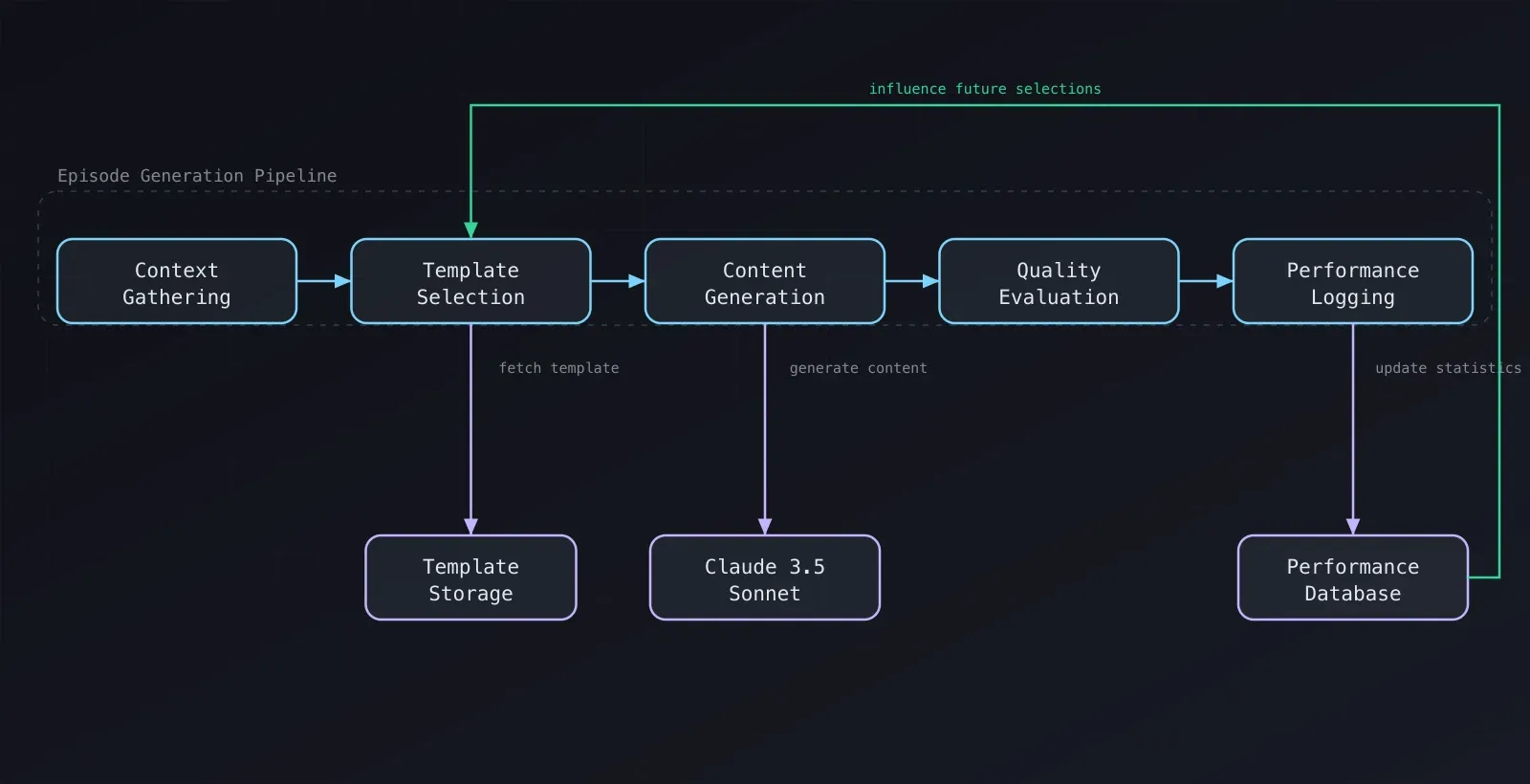
The architecture follows a clear flow that separates different types of decision-making. Context gathering assembles all the information needed for the current episode: user wellness data, recent wellness trends, previous episode themes, and any specific requirements. This context flows to the template selection component, which uses the probabilistic algorithm we just demonstrated to choose the most appropriate template.
Template selection considers both the current context and historical performance data. Templates aren’t just selected based on overall performance; they’re selected based on how well they’ve performed in similar contexts. A template that works well for low-impact exercise episodes might not be the best choice for episodes about high-intensity workouts, and the system learns these context-dependent preferences over time.
Once a template is selected, it goes to the content generation component, which fills in the template with specific details from the episode context and sends the completed prompt to Claude 3.5 Sonnet. The generated content then flows through quality evaluation, which measures multiple dimensions of performance: factual accuracy, engagement potential, readability, and alignment with the intended tone.
Finally, the performance results flow back into the performance database, creating the feedback loop that enables learning. The system captures detailed performance metrics that show which templates work well in which situations.
What Makes This Approach Powerful
The power of probabilistic prompt selection comes from how it transforms prompt engineering from a craft into a data-driven system. Instead of relying on human intuition to predict what will work, you create a framework for systematic experimentation and learning.
Consider how this changes your relationship with prompt quality. With static prompts, you’re always worried about making changes because any modification could break what’s working. With probabilistic selection, you can safely add new template variations because they’re tested gradually alongside proven approaches. If a new template works well, it naturally gets selected more often. If it doesn’t work, it gets selected rarely and eventually can be retired without disrupting the system.
This approach also scales human expertise more effectively. Instead of requiring prompt engineers to predict the perfect wording for every situation, you can have experts create multiple good approaches and let the system discover which ones work best in practice. The human role shifts from predicting performance to creating diverse, high-quality options and designing effective evaluation criteria.
Probabilistic selection also creates systems that improve continuously without manual intervention. As user preferences evolve, wellness trends change, or model capabilities shift, the system adapts by favoring templates that continue to perform well. This builds systems that adapt to new conditions instead of degrading over time.
Getting Started: Your Next Steps
If you’re convinced that probabilistic prompt selection could benefit your application, here’s how to start implementing this approach in your own systems.
Begin by examining your current prompt and identifying natural variations. Look for places where you’ve made specific choices about tone, structure, or content emphasis. Each of these choices represents an opportunity to create template variations. You don’t need to start with dozens of templates; even two or three meaningful variations can demonstrate the value of the approach.
Next, implement basic performance tracking for your generated content. You’ll need metrics that reflect what you actually care about: user engagement, task completion rates, accuracy scores, or whatever success means for your application. The key is to measure outcomes that matter instead of intermediate metrics like model confidence scores.
Then, build a simple selection mechanism using the Thompson Sampling approach we demonstrated. Start with basic success/failure tracking and gradually add more sophisticated context-aware selection as you gain experience with the system. The important thing is to begin the learning loop, not to build the perfect system immediately.
Finally, establish a process for creating and testing new template variations. This might be manual initially, but you’ll want to systematize this process as you see the value of diverse, high-quality templates. Think about how to capture the insights of your best prompt engineers in template form instead of expecting them to craft the perfect single prompt.
Looking Ahead: Building Production Systems
This introduction has shown you why probabilistic prompt selection matters and how the basic concept works. But building production systems requires addressing many additional challenges: how do you handle complex contextual matching between episodes and templates? How do you design reward functions that capture multiple dimensions of quality? How do you safely evolve your template portfolio over time? How do you monitor and debug these systems when they’re running at scale?
In the next post in this series, we’ll dive deep into the technical heart of production prompt selection systems. We’ll explore sophisticated context matching using embedding similarity, advanced bandit algorithms that handle complex reward structures, and strategies for ensuring new templates get fair evaluation without compromising quality. We’ll also examine how to incorporate content diversity and pattern recognition to create systems that don’t just optimize individual episodes, but optimize the overall content experience.
By the end of that post, you’ll have the technical foundations to build scalable prompt selection systems that improve your content quality while reducing manual oversight. The goal is to turn prompt engineering from a bottleneck into an automated capability that makes your applications better over time.
The shift from static prompts to adaptive systems changes how we build LLM applications. Instead of predicting the perfect prompt upfront, we build systems that learn the best prompt for each situation through experimentation and data.
Prefer plain text? Read this as Markdown.